Corsair Grand Touring Battery Charging / Draining Issues

So, I am storing my car in the garage. A very dangerous thing to do as the opening of the garage is tight. I am afraid one of these days I am going to scrape/dent the vehicle backing it in. However, it's advantageous for charging.
Don't forget you can push a button to fold the mirrors manually.

Question: How do I set the car up for preconditioning? In other words, how can I start it so the car heats up while plugged in so that energy is not wasted? Are there preconditioning settings somewhere? And all I need to do is start the vehicle with the keyfob and as long as the drive mode is in Pure EV it will always start in that mode?
The car always starts in the Normal drive mode (one of my pet peeves). However, it's not in any specific drive mode when it preheats. Look for the relevant settings under Remote Start. Also, I find it easier to do this from the app. You don't need to have the key fob or be within range. For example, you can start the preheat while sitting at the breakfast table 5 minutes before heading out. You can even program a schedule for it.
 
Don't forget you can push a button to fold the mirrors manually.


The car always starts in the Normal drive mode (one of my pet peeves). However, it's not in any specific drive mode when it preheats. Look for the relevant settings under Remote Start. Also, I find it easier to do this from the app. You don't need to have the key fob or be within range. For example, you can start the preheat while sitting at the breakfast table 5 minutes before heading out. You can even program a schedule for it.

mfjj.

I take it that the vehicle will put into motion the last settings you had before turning off the vehicle.

So, if you want your car to heat to 75 degrees, and want the seat and wheel heated, these must be activated before you turn off the vehicle?

Remote Start on the Lincoln Way app doesn't let you play with these settings (as far as I can see), only limiting to starting and stopping the vehicle.
 
mfjj.

I take it that the vehicle will put into motion the last settings you had before turning off the vehicle.
So, if you want your car to heat to 75 degrees, and want the seat and wheel heated, these must be activated before you turn off the vehicle?
Not necessarily. See below.

Remote Start on the Lincoln Way app doesn't let you play with these settings (as far as I can see), only limiting to starting and stopping the vehicle.
I meant it's easier to use the app to remote start. The initial setup should be done in the car. From the center screen on the dashboard, press Settings > Vehicle > Remote Start Setup, and go from there.
 
Last edited:
So, if you want your car to heat to 75 degrees, and want the seat and wheel heated, these must be activated before you turn off the vehicle?

The app route I take is Vehicle icon, Charging, Charge Settings, Departure Times. The options for Cabin Temp to be Cool, Medium, Warm, or off. I'm not sure about steering wheel heater. Seat seems to remember last setting but won't activate until you start the car. Steering wheel seems to need to be turned on each start. ( I could be wrong - 65 here so my "winter" has past).
______________________________
 
A great video on getting optimal mileage with a PHEV. Question to follow at the end of the videos...


Some tips on charging the PHEV.


So, I am storing my car in the garage. A very dangerous thing to do as the opening of the garage is tight. I am afraid one of these days I am going to scrape/dent the vehicle backing it in. However, it's advantageous for charging.

Question: How do I set the car up for preconditioning? In other words, how can I start it so the car heats up while plugged in so that energy is not wasted? Are there preconditioning settings somewhere? And all I need to do is start the vehicle with the keyfob and as long as the drive mode is in Pure EV it will always start in that mode?
Answer: The LIncolnWay app on your mobile phone can set up schedules for heating or cooling the car as long as you have the charger hooked up and it will use that electricity source to do the warming/cooling preconditioning. I think with practice you will be able to get it into the garage. The charging cords are quite long on the supplied charging cord or the 3rd party like I use (ChargePoint Home). I can either back the car in or drive in directly and the cords are long enough to reach.
 
Hi all - I'm a new Lincoln Corsair GT owner, so please excuse me if this has been asked before...

The salesman at the dealership was adamant that I should never charge the Corsair EV battery up to 100%, as that would degrade the battery over time. But from what I can tell, there is no way to set the charger to stop charging when it reaches 80%-90% (the salesman's suggested charge level). Also, our plan is to charge the car using our 240 volt Level 2 charger overnight when our electricity rates are at their lowest, so the charge will be hitting the 80%-90% level somewhere around 2am, when I will be unlikely to consistently get out of bed to unplug the charger.

So my question is this: was the salesman correct about the need to limit the charge to 80%-90%, and if so, how can I do that? If the battery is not meant to be fully charged to 100%, I am thinking that perhaps Lincoln was wise enough to put a system in place in which the charger naturally only charged up to the 80%-90% range. Otherwise, they would be opening themselves to lots of lawsuits from Corsair owners with EV batteries that died prematurely.

Any thoughts on this matter would be appreciated.
 
The slower the rate of charge, the longer the battery will last, so I wouldn't use those ultra quick charge units, but I'm a slow person, so that's just me. Tesla is now telling its customers 15%-60% charge is best, but todays car batteries should last 8yrs even if you rapid charge it to 100% everytime, so unless you are going to keep Corsair for 15-20yrs, I wouldn't worry about it. Every EV charger and battery has a limiter, otherwise it would be possible to overcharge (over 100%). I read Ford limits to 3%, 97%, although your car will say 0%, 100%. I don't own an EV except bikes, so maybe others know more. Hope this helps.

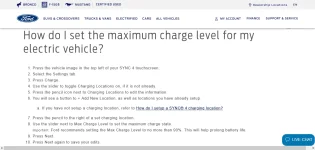
Here's some instructions I found:
Screenshot 2022-08-09 at 19-59-42 How do I set the maximum charge level for my electric vehicle.webp
 
My actual knowledge is with the. various Prius I have owned but they refuse to charge over 80% (but they show that as full) and refuse to discharge under 25% (and claim that is empty)

I strongly suspect Lincoln does the same.

While pure EVs often support fast DC charging, PHEVs all charge very slowly. I think max for a Tesla is 500 amps at 480 volts, the max for a Grand Turing is 16 amps at 240 volts, MUCH slower.
______________________________
 
Last edited:
I charge mine at 240v in my garage every time I get home, though I try to keep it unplugged during thunderstorms. The last two full charges reported 37 and 38 mile ev range, highest ever, after 8 months and about 3700 miles of mostly-ev driving. My view is that with the short electric range of a PHEV, you can't afford to worry about battery life. I just revel in the electric ride, and the great gas mileage in hybrid mode on those infrequent longer local trips.
 
Your vehicle is equipped with hardware and software that will limit the charge to the vehicle. As it gets closer to 100% the charging rate will slow down. It does not matter if you use a Level 2 charger, 240V outlet with your Lincoln supplied charging cord or 120V outlet with the Lincoln supplied charging cord. Both the Level 2 charger and 240V outlet with the Lincoln supplied charging cord will take approximately 3 - 3.5 hours to fully charge a depleted battery. The 120V outlet with the Lincoln supplied charging cord will take much longer at around 11 - 11.5 hours. The owner's manual does not specify that charging to 100% is bad. The EV battery is warrantied for the lifetime of the vehicle, whatever that means.

I was charging my vehicle daily no matter what was left in the EV battery. Most of my driving is around town so I have now gone to charging every 2 - 3 days.
 
The slower the rate of charge, the longer the battery will last, so I wouldn't use those ultra quick charge units, but I'm a slow person, so that's just me. Tesla is now telling its customers 15%-60% charge is best, but todays car batteries should last 8yrs even if you rapid charge it to 100% everytime, so unless you are going to keep Corsair for 15-20yrs, I wouldn't worry about it. Every EV charger and battery has a limiter, otherwise it would be possible to overcharge (over 100%). I read Ford limits to 3%, 97%, although your car will say 0%, 100%. I don't own an EV except bikes, so maybe others know more. Hope this helps.

Here's some instructions I found:
View attachment 14471
Thanks for your reply 11MarkX. The photo you attached suggests that we set the charge to a maximum of 90%, but the 2022 model of the car comes with Sync 3, not Sync 4, and it appears that Sync 3 does not provide the option of setting a maximum charge level.
 
My actual knowledge is with the. various Prius I have owned but they refuse to charge over 80% (but they show that as full) and refuse to discharge under 25% (and claim that is empty)

I strongly suspect Lincoln does the same.

While pure EVs often support fast DC charging, PHEVs all charge very slowly. I think max for a Tesla is 500 amps at 480 volts, the max for a Grand Turing is 16 amps at 240 volts, MUCH slower.
Thanks for your reply Jimbo. From what I have been reading online, pretty much all of the EV cars appear to have have automatic limiters on the chargers. Unfortunately, the manual makes no mention of this matter (at least not that I have found).
______________________________
 
I charge mine at 240v in my garage every time I get home, though I try to keep it unplugged during thunderstorms. The last two full charges reported 37 and 38 mile ev range, highest ever, after 8 months and about 3700 miles of mostly-ev driving. My view is that with the short electric range of a PHEV, you can't afford to worry about battery life. I just revel in the electric ride, and the great gas mileage in hybrid mode on those infrequent longer local trips.
Hi Wilbur - thanks for your comment. I too am enjoying the electric ride on short trips, as that was my main motivation in buying the Corsair GT.
 
Your vehicle is equipped with hardware and software that will limit the charge to the vehicle. As it gets closer to 100% the charging rate will slow down. It does not matter if you use a Level 2 charger, 240V outlet with your Lincoln supplied charging cord or 120V outlet with the Lincoln supplied charging cord. Both the Level 2 charger and 240V outlet with the Lincoln supplied charging cord will take approximately 3 - 3.5 hours to fully charge a depleted battery. The 120V outlet with the Lincoln supplied charging cord will take much longer at around 11 - 11.5 hours. The owner's manual does not specify that charging to 100% is bad. The EV battery is warrantied for the lifetime of the vehicle, whatever that means.

I was charging my vehicle daily no matter what was left in the EV battery. Most of my driving is around town so I have now gone to charging every 2 - 3 days.
Thanks RedHoncho. I suspect my charging habits will be similar to yours (not sure as I have only had the car for 5 days). Glad to hear that the Corsair GT has a limiter that will prevent me from degrading the EV battery by overcharging.
 
I've owned and driven many Hybrids since 2007. Never a PEHV, but still hybrids. When the instrumentation on the dash indicates a 100% charge, this a "fake" 100%, as the manufacturers know that to achieve a longer useful battery life, they need to not allow a "true" full charge or a "true" fully depleted charge. I am 99% sure that the GT is the same way.

It is probably possible to achieve a true 100% charge on a long down hill run, but the electronics will do their darndest to deplete some of that charge.
 
Thanks for the link. Much better understanding of Regen braking now.
 
In Conserve your car accelerates slowest and decelerates fastest (max regen) so in general, yes best mode to save gas/electric-energy. But, Pure EV will give you the best “miles per gallon” (of gas) for the first 25-30 miles since you’re burning NO gas. This is how (with my short commute) I’m 1000+ miles burning 12 gallons. Enjoy!
Very well done!
 
Yesterday. I received the BATTERY SAVER MODE message on both my 22 Corsair as well as my 23 Maverick. Being retired, I don't drive much in the Winter months, however, I drive each of my vehicles at least every 2 days. I hooked up a battery charger on both. The Corsair showed only 60 percent charge, and the Maverick 50 percent. Needless to say, both vehicles will be charged to 100%.

What gives with FORD's battery management system? I've owned many different vehicles from various manufacturers through the years and never had a vehicle where the battery has drained so low. I know that all new vehicles have various electronic components that are constantly drawing power. My other modern vehicles including Jeep, Buick, Chevy, and GMC never had this issue. Any input would be appreciated.
 
I think it’s just Ford batteries suck ! They last two years if you’re lucky. Anything longer you’re bordering on getting stuck. I always replace when it’s time with AutoZone Duralast platinum. Cars are always ok after that. That’s my thoughts. Anyone else lol ?
 
Back
Top