• 🔍 Like our community? You can tell Google to show you results from this site more often. Just Click Here and then click the empty checkbox on the right side of our name.

Did Lincoln make a fatal mistake killing off sedans? Or was it the right move?

As an Amazon Associate we earn from qualifying purchases.
I bet that IF Ford/Lincoln retooled the line and started remaking the Panther platform their sales would be off the charts. Just another 5-10 yr. run
Ford Motor Company is betting the other direction.

Since the platform has been discontinued for 15 years, there is no tooling or dies left. (What could be reused was and the rest of any metal was scrapped) IE Wixom is no longer with us folks!
They would have to start from zero which would make it just as expensive as creating any other new vehicle line. That is a multimillion dollar bet.
Since they do not have a sedan now and have publicly stated they are out of the sedan market. Much less the luxury sedan market. We are not going to see an updated Town Car. It just doesn't make economic sense for the company to make a sedan now when that is not their focus. And trust me it isn't because the company likes the look of trucks. It is a purely an economic decision. Ford will build anything that is in their general market and is profitable and can be done for an extended length of time. For now that time would be at a minimum of 5 years. They have to recover the initial investment.

Plus all manufacturers will be anxious to see about the 2028 election, which is not far off. If the Feds mandate zero or near zero emissions, that will take a lot of cash. To some extent Ford and some other company's made the investment to go there. Which did not pan out. Making bets is not prudent.

Action
 
Last edited:
@Action you raise some excellent points in this discussion, especially around the real economics of vehicle programs. The lack of any remaining Panther tooling, the high cost of retooling from scratch, soft broad retail demand for traditional sedans, and Ford/Lincoln’s disciplined focus on higher margin SUVs and trucks are all valid reasons why a new Town Car hasn’t happened. The shift away from sedans wasn’t arbitrary - it was driven by profit per unit and where buyers actually spent money.

That said, I think there’s a plausible scenario where a new Lincoln Town Car could be built profitably without trying to revive the old broad retail sedan strategy. The key would be positioning it primarily as a fleet and livery focused vehicle with upscale halo trims for retail and brand image. Lincoln dominated professional transportation for decades with the Town Car. Many livery operators, black car services, and corporate fleets still value (or used to value) the combination of rear seat comfort, trunk space, durability, and professional presence that a proper full-size sedan provides - something SUVs don’t fully replace for every use case.

A modern version could work with a simplified, durable base model tailored for fleets (telematics ready, robust components, efficient powertrain) to generate the volume needed to amortize development costs over a long production run. Higher margin “Signature” or “L” trims with executive rear seating, premium materials, and distinctive styling could then serve as halo models that boost brand prestige and help sell the rest of the Lincoln lineup. A hybrid powertrain (building on Ford’s existing hybrid expertise) would make strong sense here for lower fleet operating costs and alignment with current industry trends toward profitable electrification rather than pure EV risk.

This wouldn’t be “bringing sedans back” in the old sense - it would be a targeted niche product that plays to Lincoln’s historical strengths in professional transport while fitting today’s realities around platform sharing, hybrid efficiency, and lifetime revenue from parts and service. It’s not guaranteed or easy, and you're is right that the economics have to pencil out with a clear multi year path to profitability. But a fleet centric approach with halo variants feels like one of the few realistic ways it could actually work without ignoring the hard business constraints you outlined.
 
@AChura75
Thanks for that point of view.

I do have some limited experience with fleet sales
Before I go there, that scenario would have to make financial sense to all parties.
The manufacturer (in this case Ford) is going to have to invest millions to bring a product to marketplace
Then is it going to be marketed to fleet buyers directly and upset the Dealer Association. Or if dealers get involved there is an added level of expense.

Long time ago when I worked for the company (In the Parts and Service capacity) and called on dealers I had the opportunity to chat with a fleet sales manager. He was in the middle of making a proposal to a government entity (local I think) regarding a fleet purchase. Something like 50 to 100 units)
He explained to me that the gross profit to the dealership per unit was a dollar IF all units were the same. It was just a matter of creating an order and then doing it 50 more times. If there was a mix of units the profit increased because there was more labor in making sure everything was correct.
The dealership's real money came from the dealer hold back. At the time it was 2%. Also these units were financed as most new vehicles were. And the terms were usually free interest for the first 30 days or so. Since these units came off of the dealer financing almost as fast as the unit hit the dealership there was NO change. BUT The dealership needed a huge line of credit to pull this off. Meaning any dealership negative credit issues were not tolerated. So dealership finance guys and anyone else that handled money had to go through a very tough background check that might not have happened at other dealerships. (IE added expense)

That is kind of a long explanation to say there isn't a lot of money in the sale of fleet vehicles. And it is money that is driving all of these decisions.
An argument in favor of that would have to be generated to show that there is a profit reason (over a sustained period) that can be made.
The link below while showing a some negative news about fleet sales underlines the size of the market you are speaking about.
Fleet sales in total are at best a couple of hundred units. Up for grabs by ALL vehicle makers.
Worst yet the market the "new Town Car" would be in. That is a 70 or 75 thousand unit niche.
If Ford could capture a certain percent of that, (my guess would be 50% or more) it might make some sense.


Back when I worked there, it was a given that a new model or a new generation of model had to cover costs and return a profit in a 3 year term. There is a lot more to that but the overall picture. When there is a lot going on, or uncertainty, rolling out a new thing doesn't make it to the top end of the list.

Action

 
@AChura75
Thanks for that point of view.

I do have some limited experience with fleet sales
Before I go there, that scenario would have to make financial sense to all parties.
The manufacturer (in this case Ford) is going to have to invest millions to bring a product to marketplace
Then is it going to be marketed to fleet buyers directly and upset the Dealer Association. Or if dealers get involved there is an added level of expense.

Long time ago when I worked for the company (In the Parts and Service capacity) and called on dealers I had the opportunity to chat with a fleet sales manager. He was in the middle of making a proposal to a government entity (local I think) regarding a fleet purchase. Something like 50 to 100 units)
He explained to me that the gross profit to the dealership per unit was a dollar IF all units were the same. It was just a matter of creating an order and then doing it 50 more times. If there was a mix of units the profit increased because there was more labor in making sure everything was correct.
The dealership's real money came from the dealer hold back. At the time it was 2%. Also these units were financed as most new vehicles were. And the terms were usually free interest for the first 30 days or so. Since these units came off of the dealer financing almost as fast as the unit hit the dealership there was NO change. BUT The dealership needed a huge line of credit to pull this off. Meaning any dealership negative credit issues were not tolerated. So dealership finance guys and anyone else that handled money had to go through a very tough background check that might not have happened at other dealerships. (IE added expense)

That is kind of a long explanation to say there isn't a lot of money in the sale of fleet vehicles. And it is money that is driving all of these decisions.
An argument in favor of that would have to be generated to show that there is a profit reason (over a sustained period) that can be made.
The link below while showing a some negative news about fleet sales underlines the size of the market you are speaking about.
Fleet sales in total are at best a couple of hundred units. Up for grabs by ALL vehicle makers.
Worst yet the market the "new Town Car" would be in. That is a 70 or 75 thousand unit niche.
If Ford could capture a certain percent of that, (my guess would be 50% or more) it might make some sense.


Back when I worked there, it was a given that a new model or a new generation of model had to cover costs and return a profit in a 3 year term. There is a lot more to that but the overall picture. When there is a lot going on, or uncertainty, rolling out a new thing doesn't make it to the top end of the list.

Action

Thanks for the detailed reply and for sharing your firsthand experience with fleet sales and dealer operations - that's valuable context I don't have. You're right that pure fleet deals often carry very thin margins for the dealership (sometimes just a few dollars per identical unit, with the real money in holdback, financing, and aftermarket). That reality has to be part of any serious discussion.

Where I see a potential path is by looking at it from the manufacturer's perspective rather than just the dealer's transaction margin. Ford/Lincoln wouldn't be relying solely on rock bottom fleet volume at slim per unit profit. The model could combine:

- A durable, efficient base version aimed at professional/livery fleets (where Lincoln historically had strong pull and operators often prioritize total cost of ownership, reliability, and passenger comfort over the absolute lowest price).
- Higher content "Signature" or executive halo trims sold at stronger retail or near retail prices. Those higher ASP units improve overall mix and margins on the same platform.

Even in a niche you estimate around 70-75k units industry wide, capturing a meaningful but realistic share (leveraging the Town Car name and heritage) plus the halo retail sales could generate enough volume and revenue mix to support the program - especially if development costs are controlled by sharing architecture and powertrain components with existing or upcoming Lincoln/Ford vehicles. The aftermarket side (parts and service on high mileage fleet vehicles) also adds meaningful long term revenue that pure retail programs don't always capture at the same rate.

You're also correct that any new program needs a clear path to sustained profitability, not just short term volume. The old 3 year payback expectation is real, but modern programs with heavy platform sharing and modular hybrid powertrains can improve the economics and timeline compared to fully standalone models of the past. Ford's current emphasis on profitable hybrids rather than all in EV bets also changes the risk profile a bit.

The article you linked highlights how overall fleet sales (especially rental) can be cyclical and pressured. Professional/livery and executive transport demand tends to be more stable and values different attributes - comfort, durability, and low operating costs - which a properly executed modern Town Car could target.

I completely agree the numbers have to work carefully for all parties, including dealers. A program like this would likely need smart fleet specific incentives or direct channels that don't overly disrupt dealer economics, while still allowing the halo versions to flow through normal retail. It wouldn't be easy, and it might not be a huge volume play - but it could be a profitable niche one that plays to Lincoln's historical strengths.

Appreciate you laying out the real world constraints so clearly. Do you see any way the economics could be made to work if the vehicle was positioned more as a premium professional tool (rather than a commodity fleet vehicle) with strong aftermarket and halo support?
 
The problem with all of this is Ford has stated very clearly and has stuck to the position, no more sedans. And basically, no more cars.
I do not see Ford making this kind of vehicle at all.
They know how to make trucks/CUVs/SUVs and make money at doing it. A lot of money! Until the market moves (and it will) I think Ford will stick with what you see.

The elephant question hanging out there is Government Mandates to build battery vehicles. Capital is being massed to throw at that problem.
And coming is more expensive tech with AI creating a vehicle center for connecting while driving. And may be user customizable driving experience.
Plus the driverless vehicles. All of that will consume huge monetary resources.

If the car world was stagnant or even slower to change it might be different. But the industry changes so fast. To meet the demand of the consumer and the government, the company has to be ready to change or be left in the dust. The Town Car or professional livery is a niche. In my opinion Ford isn't up for niches like that. The only niche currently is vehicles/assemblies with lots of flash. The super car or six figure Mustang variant that will have pre-orders for years in advance. Ford has done this a number of times, with a totally separate team. And buyers that do not blink at a robust 6 figure entry fee.

I could be wrong, however the future does not appear to have much demand for the ride you have outlined. Maybe a low volume vehicle customizer would step in.

Action
 
The problem with all of this is Ford has stated very clearly and has stuck to the position, no more sedans. And basically, no more cars.
I do not see Ford making this kind of vehicle at all.
They know how to make trucks/CUVs/SUVs and make money at doing it. A lot of money! Until the market moves (and it will) I think Ford will stick with what you see.

The elephant question hanging out there is Government Mandates to build battery vehicles. Capital is being massed to throw at that problem.
And coming is more expensive tech with AI creating a vehicle center for connecting while driving. And may be user customizable driving experience.
Plus the driverless vehicles. All of that will consume huge monetary resources.

If the car world was stagnant or even slower to change it might be different. But the industry changes so fast. To meet the demand of the consumer and the government, the company has to be ready to change or be left in the dust. The Town Car or professional livery is a niche. In my opinion Ford isn't up for niches like that. The only niche currently is vehicles/assemblies with lots of flash. The super car or six figure Mustang variant that will have pre-orders for years in advance. Ford has done this a number of times, with a totally separate team. And buyers that do not blink at a robust 6 figure entry fee.

I could be wrong, however the future does not appear to have much demand for the ride you have outlined. Maybe a low volume vehicle customizer would step in.

Action
Thanks again for the thoughtful reply. You're right that Ford has been very consistent publicly about exiting sedans and focusing on trucks, CUVs, and SUVs where they make strong money. That track record matters, and any new program would have to overcome that institutional momentum.

Where I still see a narrow window is that strategy statements aren't always permanent when the economics or market conditions shift - especially if a vehicle can be executed with lower incremental investment through heavy platform and powertrain sharing rather than a clean sheet program. A Town Car style vehicle doesn't necessarily need to be a big standalone "car" project competing for the same capital as next gen EVs, AI integration, or autonomous development. It could potentially be a body style variant or specialized professional version built on architecture already in use or planned.

The professional/livery and executive transport niche is small, as you noted, but it has different requirements than mainstream retail - rear seat comfort, durability under high miles, low total cost of ownership, and a traditional luxury presence that many current SUVs don't fully replicate for certain clients. Lincoln owned that space for a long time. If a modern version could be positioned as a premium professional tool (with halo retail versions) rather than a high volume commodity, it might not need to be a massive program to contribute positively.

I agree the industry is moving fast and resources are finite. Ford has shown it will pursue certain high attention niches (special Mustang variants, etc.) when the pre-order demand and margins justify a dedicated effort. The question is whether a lower volume but high image professional sedan with hybrid efficiency could ever clear that same internal bar, or whether the current focus on SUVs plus big future tech bets makes even a smart niche play unlikely.

You're probably correct that under today's exact strategy and priorities, it doesn't look probable. But corporate strategies do evolve when new data shows a clear, lower risk opportunity that leverages existing strengths. Appreciate you laying out the bigger picture on where Ford is actually allocating capital.

Do you think there's any realistic path for Lincoln to re-enter a limited professional/livery sedan space in the next 5-7 years, or do you see the "no more sedans/cars" stance as effectively permanent for the foreseeable future?
 
I think most Lincoln execs would love to buck the Ford mandate but they have zero leverage, at least in the current market and immediate future. They have been on a short leash since Lincoln broke from the Premier Automotive Group. Then along came 2008-2010 auto industry crisis. Lincoln was lucky to survive.

And @Action is correct... like it or not, the elephant in the room is the Feds.
 
Do you think there's any realistic path for Lincoln to re-enter a limited professional/livery sedan space in the next 5-7 years, or do you see the "no more sedans/cars" stance as effectively permanent for the foreseeable future?

I thought I answered that already.
Short answer is no!

Longer one is the next 2 or 3 models years are getting firmed up right now.
Some market condition has to change to jump into a small low profit niche. Meaning the unknowns have to become known.
Otherwise the company is sitting on a pile of cash to meet the unknown.

This vehicle would be a niche. The company only sems to be willing to invest in high dollar niche markets for now.
Frankly that Mustang is very outside the product mix. So far outside it has its own department. The car is a more or less custom super car. And it is not the first time for this niche. As long as there are buyers willing to pony up to the $300,000+ entry fee, these one offs will be made.

As to a livery ride, some outside company is going to need to take an existing ride and cut it up. That may turn out to be a SUV and not a car.

Actiom
 
Lincoln dropping all sedans was definitely a shock at the time, but honestly they were barely selling any compared to the SUVs. The MKZ and Continental were good cars but they just couldn't compete with the Germans on performance or with Cadillac on the sporty side. For the traditional buyers who loved those big luxury sedans, it was a slap in the face, but the numbers probably made the decision easy. I've seen some MKZ owners move into the Nautilus and say it's a good compromise, but it's still not the same. Do you think you would have bought a Continental over one of their current SUVs if it was still available?
 
Lincoln dropping all sedans was definitely a shock at the time, but honestly they were barely selling any compared to the SUVs.

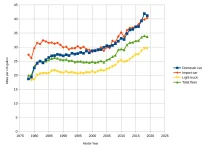
"Lincoln" did not drop all sedans, Ford did. I can assure you folks at Lincoln were all but begging Ford not to axe their line of products. But as I said, they had no leverage despite a growing share in the China market at the time. But the reality all automakers faced was the ever sharply increasing CAFE standards...

CAFE_performance.svg.webp
Do you think you would have bought a Continental over one of their current SUVs if it was still available?

Likely not for the price point they would be selling for.
 
Yeah that's a fair point, it was Ford pulling the plug not Lincoln. I'm sure the Lincoln guys were pissed about it, especially since the Continental was actually getting some love. The CAFE standards thing definitely forced a lot of hands across the industry. It just stings because they finally got that car right and then killed it. You think they'll ever bring a sedan back now that Ford seems to be pivoting again?
 
Yeah that's a fair point, it was Ford pulling the plug not Lincoln. I'm sure the Lincoln guys were pissed about it, especially since the Continental was actually getting some love. The CAFE standards thing definitely forced a lot of hands across the industry. It just stings because they finally got that car right and then killed it. You think they'll ever bring a sedan back now that Ford seems to be pivoting again?
I think Ford/Lincoln sedans will return some day soon, Toyota and Honda own that market without any other competition offering gas, hybrid, and electric models.
 
Thanks @driller for the added context on Lincoln’s limited leverage with Ford. That helps explain why the sedan decision felt so abrupt even when the Continental was starting to get some positive attention. The CAFE pressure and post crisis realities clearly played a big role across the industry.

@Action, I hear you on the planning cycle. If the next 2-3 model years are already being locked in and the company is holding cash for bigger unknowns (mandates, AI/tech integration, autonomy), then a small professional/livery niche probably doesn’t rise high enough on the priority list right now. That makes sense. The fact that Ford is willing to do very high dollar, low volume outliers like the special Mustang variants (with their own team and $300k+ pricing) shows they’ll make exceptions when the margins and demand are extremely strong, But a more traditional professional sedan doesn’t fit that same flash + big margin profile.

I still think there’s a difference between a full new sedan program and something more limited, like a factory supported professional package or a body style variant on an existing or upcoming platform (similar to what Lincoln did with the MKT Town Car Livery years ago). That kind of approach could potentially keep incremental investment lower while still serving the livery/executive transport space that historically suited Lincoln well. An outside customizer modifying an SUV or existing vehicle is one possibility, but a factory version might carry more credibility and support with professional operators.

You’re probably right that under current conditions and priorities it’s unlikely in the near term. The combination of firm product planning, capital needs for future tech, and the proven success of the SUV/truck side makes the “no more sedans/cars” stance feel pretty solid for now. Appreciate you being direct about it.

Curious what others think about @MORSNO’s point. Do you see any realistic chance of sedans returning in some form once the current EV/hybrid/autonomous wave settles, or is the shift to utility vehicles permanent for Lincoln?
 
@Action, I hear you on the planning cycle. If the next 2-3 model years are already being locked in and the company is holding cash for bigger unknowns (mandates, AI/tech integration, autonomy), then a small professional/livery niche probably doesn’t rise high enough on the priority list right now. That makes sense. The fact that Ford is willing to do very high dollar, low volume outliers like the special Mustang variants (with their own team and $300k+ pricing) shows they’ll make exceptions when the margins and demand are extremely strong, But a more traditional professional sedan doesn’t fit that same flash + big margin profile.
It is all about the money!
It is always all about the money.
Should anyone forget, just remember it's is about the money.

The company has been on the brink a couple of times. Not like Chrysler on the brink, and on the brink none the less.
The current management team isn't up for making anything that isn't a clear seller on the show room.
Years past some "experimenting" was done. Especially in the LM division. That isn't happening in the foreseeable future.

Here is the fiscal year annual NET income back to 2006. Looking at this the company has to has the cash to make it past years that it doesn't have the income. BTW that 2025 neg number. That is the loss on electric vehicles that did not happen as planned.
https://www.bing.com/ck/a?!&&p=70c4...ydHMvRi9mb3JkLW1vdG9yL2dyb3NzLXByb2ZpdA&ntb=1

Annual Net Income (FY) FinanceCharts.com

  • 2025: $-8.18B (↓239% from 2024)
  • 2024: $5.88B (↑35% from 2023)
  • 2023: $4.35B (↑319% from 2022)
  • 2022: $-1.98B (↓111% from 2021)
  • 2021: $17.94B (↑1,502% from 2020)
  • 2020: $-1.28B (↓2,821% from 2019)
  • 2019: $47M (↓98% from 2018)
  • 2018: $3.68B (↓52% from 2017)
  • 2017: $7.73B (↑68% from 2016)
  • 2016: $4.59B (↓37% from 2015)
  • 2015: $7.37B (↑499% from 2014)
  • 2014: $1.23B (↓89% from 2013)
  • 2013: $11.95B (↑113% from 2012)
  • 2012: $5.61B (↓72% from 2011)
  • 2011: $20.21B (↑208% from 2010)
  • 2010: $6.56B (↑141% from 2009)
  • 2009: $2.72B (↑118% from 2008)
  • 2008: $-14.77B (↓428% from 2007)
  • 2007: $-2.80B (↑78% from 2006)
  • 2006: $-12.61B (no change from 2005)
Key trends:

  • Ford’s gross profit has generally been stable in the $12–27B range from 2013–2024, but fell sharply in 2025.
  • Net income has been highly volatile, with large swings between profitability and losses, especially in 2020–2021 and 2022–2025.
  • The most dramatic profit jumps occurred in 2007 (gross) and 2011–2013 (net), while the steepest declines were in 2008 (net) and 2020–2021 (net).
Summary: Over the last 20 years, Ford’s profitability has been marked by strong growth in the mid-2000s, a deep downturn in 2008–2009, recovery through 2013, and then a period of steady but lower profitability until 2025, when both gross and net profits declined sharply.

This data came from Macrotrends | The Long Term Perspective on Markets.
I did not include gross profit as the bottom line is what everyone has to deal with.

Action
 
Back
Top