2016 Navigator L 4x4 Towing Capacity

Roy T

Member
Joined
Sep 30, 2021
Messages
31
Reaction score
13
Points
8
The 2016 Ford towing guide indicates a maximum trailer weight of 8300 pounds for a 2016 Navigator L 4x4 with the heavy duty tow package. My door sticker indicates a GVWR of 7900 pounds. If you add the two numbers together you get a GCWR of 16200 pounds. But according to the manual (page 220) the GCWR is only 14900 pounds. Why the 1300 pound difference?

Edit - I think I have this figured out.

It appears that the trailer towing guide number assumes that there is nothing in the Navigator except for the driver. The combined weight of passengers and cargo is listed as 1479 pounds on the door sticker. Assuming a driver weight of 179 gets you to the 1300 pound difference. In other words, the tow guide assumes that the driver is the only thing in the Navigator.
 
Last edited:
I got around to weighing my 1979 Avion 28' trailer and my 2016 Lincoln Navigator L. The Avion is similar to an Airstream and has a GVWR of 7900 lb. I began by weighing my Lincoln with just me and a few tools in it and weighed it again with the trailer attached. The trailer has a 200 lb. Hensley weight distributing hitch, air conditioner, two size 27 lead acid batteries and two 40 lb. propane tanks that are empty. The 65 gallon water tank was empty. I loaded the trailer with the clothing, bedding, dishes and essential gear such as cords, hoses, wheel chocks. Here are the results.

2016 Lincoln Navigator L Factory Specs per stickers
GVWR 7900
Front GAWR 3700
Rear GAWR 4330
Payload 1479
Curb weight 6421 (7900 - 1479)
GCWR 14900
Max tongue 600 base or 900 lb. w/ wt. distribution hitch

Per towing guide
Max tow wt. 8300 (Assumes 150 lb. driver and no cargo)
Tongue wt. = 10% to 15% trailer wt.
Max. Trailer wt. = 6000 to 8300 considering all factors

14900 GCWR
-150 driver
-6421 curb weight (my 2016 Lincoln Navigator L)
= 8329 tow capacity

My unconnected weights
Truck 6780
Steer axle 3400
Drive axle 3380

My connected weights
GCW 13420
Steer axle 3420
Drive axle 4020
Trailer axles 5980
Trailer wt. 6640 (1979 Avion 28’ inc. essential gear)
Tongue wt. 640 = 9.6% of trailer weight

Remaining payload in truck
7900 (GVWR of truck)
-6780 (Includes driver)
-640 - 790 (hitch weight assuming 10% of trailer)
= 150 - 480 lb. remaining passengers and cargo

Remaining trailer capacity
7900 (GVWR of trailer)
-6640
1260 lb. gross remaining trailer payload

Likely remaining trailer payload
1260
-542 (65 gallons water)
-80 (propane)
=683 lb. remaining trailer capacity

The bottom line for my trailer is that the Navigator won't have any trouble towing it as long as I watch my weights. I'll be taking a trip west with just one passenger so I'll remove the two captain's chairs to save some weight for the passenger. I'll still have the third row seat if needed.
 
Last edited:
Roy, you have done a terrific of researching and explaining the towing capabilities of your Navigator, thanks for sharing your data.

I am sometimes amazed at what some people are towing, or think what they can tow safely. You just know "the tail is wagging the dog" when the front end of their tow vehicle is almost being lifted off the ground and what they are pulling is 3-times larger than their tow vehicle.
 
Thanks for the complement. I came away from the exercise a little disappointed with Ford because they seem to be much more interested in marketing than safety when it comes to towing. For example, the heavy duty tow package came standard on my 2016 Navigator Reserve but is now optional. While the sales brochure shows that the tow package is optional, it doesn't show what the standard tow capacity is anywhere in the brochure (6200 lb.). Instead it shows the tow capacity is 8300 lb. and has a tiny footnote that says "when properly equipped" meaning that you need to order the heavy duty tow package. I feel sorry for one of our members who had five different dealers tell him that his Navigator Reserve could tow 8300 lb. without the tow package because this is plain wrong.

I'm also disappointed that they don't explain what the tow capacity number actually is. Simply stated, it is the combined weight of the trailer, passengers and cargo. Any weight you add to one must be subtracted from the other and you can't exceed the GVWR of either the tow vehicle or trailer.
______________________________
 
So true, this information for a vehicle that is built for towing should be right on the door sticker. Why hide it in the fine print?

I'm usually not a fan of a federal regulation but this seems to be a case where some oversight is needed. If a vehicle is manufactured and marketed with the ability to tow, the information for its capabilities with respect to weight should be clearly displayed somewhere on it like the door sticker and you should not have to do a bunch of calculations to determine the numbers which are critical.

Additionally, with all the storage compartments that trailers and RV's have today it is very easy to overload your rig, which makes understanding the numbers even more critical for your situation.
 
@Roy T

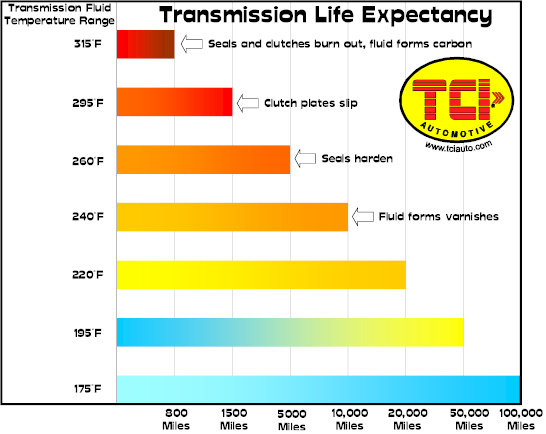
Have you thought about the fluid temperatures in the trans while you are towing. The ATF
should not exceed 175°F ideally for long periods of time ?


trans_life_expectancy.jpg


Read Bullet #4


I'm towing with my 2008 Navigator (w/towing package) an 18 foot V-Nose enclosed trailer
and my TBucket streetrod that weighs about 1700 lbs plus another 300 lbs of tools and spare
tires. Temps were reaching 220°F on flat ground when ambient temps were in the high 90's.

Have you checked your ATF fluid temps while towing ???

Seems you know more about all the tow number ratings than I do, have I exceeded one of
the ratings ??? Add another 400 lbs to the Navigator for our stuff.

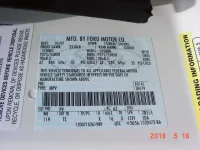
NAVIGATOR RATINGS BELOW:

FP02_LincolnNavigator_GVWR_01104.jpg

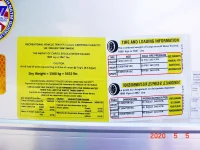
TRAILER RATINGS BELOW:

DSC02154.jpg
 
Last edited:
@Roy T

Have you thought about the fluid temperatures in the trans while you are towing. The ATF
should not exceed 175°F ideally for long periods of time ?


trans_life_expectancy.jpg


Read Bullet #4


I'm towing with my 2008 Navigator (w/towing package) an 18 foot V-Nose enclosed trailer
and my TBucket streetrod that weighs about 1700 lbs plus another 300 lbs of tools and spare
tires. Temps were reaching 220°F on flat ground when ambient temps were in the high 90's.

Have you checked your ATF fluid temps while towing ???

Seems you know more about all the tow number ratings than I do, have I exceeded one of
the ratings ??? Add another 400 lbs to the Navigator for our stuff.

NAVIGATOR RATINGS BELOW:

View attachment 12039

TRAILER RATINGS BELOW:

View attachment 12040
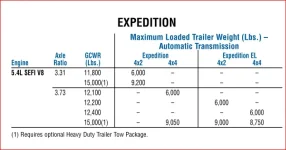
The number that has biggest impact is the GCWR (Gross Combined Weight Rating). Some of the Ford Towing Guides list this number and for others you need to check the manual. Per the towing guide, the 2008 Navigator with a tow package has a 15000 lb. GCWR. But the tow capacity varies depending on whether it's a 4x2 or a 4x4, the axle, and whether it's a standard or L model. Tow capacity between all models with a tow package range from 9200 lb. for a standard 4x2 with a 3:31 axle down to 8750 lb. for a model L 4x4 with a 3:73 axle. These assume the only thing in the tow vehicle is a 150 lb. driver.

The door sticker shown appears to be the manufacture's specs from your trailer and will apply no matter what tow vehicle you tow it with. But you can still use this to work out the numbers for your Lincoln. Per the door sticker, the dry weight of the trailer can't exceed 3452 lb. and the cargo can't exceed 3547 lb. or 6999 lb. total. Assuming you have the standard model 4x2 with a 3:31 axle with a tow capacity of 9200 lb., subtract 6999 from 15000 and you end up with 8001 lb. This is the maximum weight of the tow vehicle and includes the weight of the vehicle, all the passengers and cargo, and the tongue weight of the trailer. But the GVWR of your Lincoln is only 7500 lb. This means that if your trailer is fully loaded it is 501 lb. over the GVWR of the Lincoln. But you may still be OK because you say you're only putting 2000 lb. in the trailer. You may be able to move the 501 lb. overage to the trailer and solve your problem.

The bottom line is that you need get your Lincoln and trailer weighed as I described in my earlier post. Knowing your actual weights allows you to make adjustments to remain within factory specs by either reducing weight or shifting weight from the tow vehicle to the trailer. I've never check the transmission temperature but do change it at the recommended intervals and didn't have any trouble towing a similar size trailer with my 2007 Expedition EL You also need to be sure to use the towing mode.
 
Last edited:
There's a button on the side of the gear shift lever that essentially locks out overdrive so the transmission operates in a lower gear.
 
OK, I knew about that, just forgot about it.

Using cruise control and doing 70 mph, the trans downshifts sometimes to the point where the rpm's are about 4200 rpm. My rear gear is a 3.73. Seems the towing mode would have the rpm's up pretty close to that much of the time. But maybe I don't understand how it functions, I need to try it and see how the Nav responds.
 
Generally the biggest reason not to tow in a "high gear" is that the transmission will generate heat to the point of over heating. A higher rpm will push more fluid through the transmission and keep it cooler. This cam be confirmed by monitoring your transmission temp as you drive and watching your rpm's.
 
Generally the biggest reason not to tow in a "high gear" is that the transmission will generate heat to the point of over heating.
Towing mode does not give me the option of using 5th gear, it removes all overdrive gears. In my case that's both 5th and 6th gears.

Depending on load the Torque Converter Town Car should be locked and therefore will not be generating any heat. So I wonder if the load is high enough when towing a loaded 18 foot v-nose trailer on flat land to keep the Town Car from locking.

I feel like I'm hijacking your thread at this point and probably should start my own thread on the subject of heat ???

Edit: Oops, guess this is not your thread after all, but I still feel like I've changed the subject !
______________________________
 
Last edited:
The number that has biggest impact is the GCWR (Gross Combined Weight Rating).
@Roy T

I must apologize, I didn't really give your post a proper response! You must of invested a fair amount time in your post and I appreciate that! I've been on your end and felt like the other person didn't realize how much effort I had put into my response, sometimes taking 30-60 minutes to lookup things and make sure I had all my ducks-in-a-row.

I may not get to it until after Christmas, but I do plan on reading it for the details that are there and then asking questions if needed. I have already found the Ford Towing Guide you referenced, so I have some reading to do before I can make a educated response.

Thanks again Roy T !!!
 
@Roy T

I must apologize, I didn't really give your post a proper response! You must of invested a fair amount time in your post and I appreciate that! I've been on your end and felt like the other person didn't realize how much effort I had put into my response, sometimes taking 30-60 minutes to lookup things and make sure I had all my ducks-in-a-row.

I may not get to it until after Christmas, but I do plan on reading it for the details that are there and then asking questions if needed. I have already found the Ford Towing Guide you referenced, so I have some reading to do before I can make a educated response.

Thanks again Roy T !!!
I don't have a problem with your post because it shows how to work the towing problem backwards when you start with the trailer capacity. Many people who own RV's will find it useful because you can see how the numbers change depending on where you put the cargo. For example, some people who only plan on camping in RV parks with full hook-ups can save weight by not filling the water tank.

A good rule of thumb when it comes to towing is the 80% rule. Simply stated, you should try to keep the GVW of the trailer under 80% of the stated towing capacity of your tow vehicle. For example, I tow my 28 ft. Avion that has a GVWR of 7900 lb. with a seven passenger 2016 Lincoln L that has a stated tow capacity of 8300 lb. According to the 80% rule, I should only be towing a trailer with a GVW of 6640 lb. The 80% rule accounts for the additional payload you're likely to carry in the tow vehicle including passengers, cargo and the tongue weight of the trailer. For example, if I have seven 150 lb. passengers and a tongue weight of a 664 lb. I end up close to 80% of the stated towing capacity of my Lincoln.

Navigator owners who are shopping for a travel trailer should look for one with a GVWR between 4960 lb. and 7360 lb. depending on vehicle options.
 
I get carried away sometimes. Merry Christmas.
______________________________
 
@Roy T

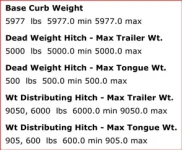
I bought the factory repair manuals and with it came the vehicle specs which contained the towing related specs shown below.

Navigator Specs

FP03_NavigatorTowSpecs.webp

Ford Towing Guide Below

FP03_FordTowGuideRatings.webp

I'm a 4x2 with a 3.73 axle ratio and a Heavy Duty Tow Package, so I read the graphic above as GCWR = 15,000 lbs and Maximum Loaded Trailer (GTW ???) as 9,200 lbs. Is that right ??? The Navigator specs show it as 9050 lbs.

With the additional info, does that change anything for me ?

I assume when you weighed your vehicle and trailer that you went to a Cat Scales ?
Are you aware of any form or list that I could use to make sure I got ALL the individual weights that I needed, so I don't have to return a second time for something I missed. Or will it take two trips to the scales to determine tongue weight?

I'm hoping that if I remove the straps holding the car, that the operator of the scales might allow me to quickly roll the car to adjust the tongue weight. Unless I'm really lucky and get it right the first time.

What speed to you like to tow at ? If you are in Towing Mode, seems you would have to drop your speed down to around 60 mph to keep the rpm's in an acceptable range.
 
You're reading the chart right. The 150 lb. difference between the Expedition and Navigator is because the Navigator has more equipment that comes standard. You will have to get separate weights to calculate your tongue weight. You won't be able to make adjustments when you're on the scales but you can usually find a spot in the parking lot where you can hitch and unhitch your trailer. You can also get a reweigh at the same scale on the same day at a discounted price.

Weight your truck first and subtract the weight from the GVWR that's found on the door post. This will show you how much remaining payload you have. Then subtract your estimated tongue weight from the remaining payload. This is going to be about 10% to 15% of the trailer weight and for your trailer with a 7000 lb. GVWR will be about 700 lb. If you don't have enough payload to accommodate the tongue you will want to see what cargo you have that you don't need or can move to the trailer to make up the difference.

Then hook up your loaded trailer and get your combined weight. Position your vehicle so the steering axle, drive axle, and trailer axle(s) are on separate scales. Then look at your numbers and see where you're at. Calculate your trailer weight by subtracting the truck weight from the combined weight. You're going to want your tongue weight to be between 10% to 15% of the trailer weight and can adjust it by adjusting the tension on your weight distributing hitch.

The manual also shows a procedure for measuring the height of the front fender well without a load and remeasuring when the trailer is connected. It specifies an acceptable difference that can be obtained with proper adjustment of the weight distributing hitch. This is a good method if you don't want to bother with going to the scales but you won't know if you're overloaded.
 
Even the first time I weigh with the Nav only, I will want to position it so that I get a separate weight for each axle ... correct ? It's this value the for rear axle compared to the rear axle with trailer that will determine tongue weight.

Looks like I'm limited to a tongue weight of 600 lbs (Stated in Nav Specs) with a weight distribution hitch, which also means I'm limited to a 4000-6000 lb loaded trailer assuming 10-15% for the tongue weight. Since just the trailer weights 3452 lbs, I can't even consider a regular hitch.

Thanks again for all your help, it's greatly appreciated !
 
The 600 lb. tongue weight is without a tow package. Since you have a tow package, your max tongue weight is 905 lb. with a weight distributing hitch and your max loaded trailer weight is 9050 lb. Without a weight distributing hitch your maximum tongue weight is 500 lb. and your maximum loaded trailer weight is 5000 lb.

It's really doesn't matter whether you get separate axle readings with the truck when it's disconnected. I weighed my truck for free at the local dump before I got my connected weight at the CAT scale.
 
Last edited:
Back
Top