120 Volt vs 220 Volt Charging

olderbudweiser

Well-known member
Joined
Dec 31, 2022
Messages
811
Reaction score
752
Points
93
Location
Florida
My Lincoln
2024 Nautilus R1 Hybrid
I have a 2023 Corsair GT on order. I’ve been reading the Webasto Charging Cable Issues thread. In doing so, looking up 220V chargers. They are a little pricey. Since the GT is capable of charging
120 or 220 V is there a problem using the 120 Volt at home outside of speed. My lifestyle is such I am rarely out of the house past 7pm, normally not going anywhere till the afternoon. There are times I may go out early. So vehicle would be plugged in 12-16 hours a day on a regular basis without the vehicle being completely discharged.

Is it necessary or desirable to install a 220V charger? Plus, minus's
 
I have a 2023 Corsair GT on order. I’ve been reading the Webasto Charging Cable Issues thread. In doing so, looking up 220V chargers. They are a little pricey. Since the GT is capable of charging
120 or 220 V is there a problem using the 120 Volt at home outside of speed. My lifestyle is such I am rarely out of the house past 7pm, normally not going anywhere till the afternoon. There are times I may go out early. So vehicle would be plugged in 12-16 hours a day on a regular basis without the vehicle being completely discharged.

Is it necessary or desirable to install a 220V charger? Plus, minus's

Great question

There are many in this forum that have the 220v charger installed.

I am only using 120-volt charging on my Corsair GT.

For me, the price of installing the 220v charger would have been a bit prohibitive. It would have cost upwards of $2k for the unit, the electrical installation, and possible repair of sheetrock that would have been damaged during that installation.

I am in the same situation as you. I only drive once a day or every few days now that I am retired. I have no problem charging my vehicle for 12-16 hours when unused.

However, the argument can be made that upgrading will only future-proof the next vehicle you buy which will probably be all-electric. I will also admit that sometimes when doing multiple drives in a single day that will exceed the charge, I have to carefully schedule those drives so I can slow-charge in between. And in those rare cases, the slow charge becomes a hindrance. However, that doesn't happen often.

For now, it seems your lifestyle is perfect for 120-volt charging. Save the money until you need to upgrade would be my advice.
 
Great question

There are many in this forum that have the 220v charger installed.

I am only using 120-volt charging on my Corsair GT.

For me, the price of installing the 220v charger would have been a bit prohibitive. It would have cost upwards of $2k for the unit, the electrical installation, and possible repair of sheetrock that would have been damaged during that installation.

I am in the same situation as you. I only drive once a day or every few days now that I am retired. I have no problem charging my vehicle for 12-16 hours when unused.

However, the argument can be made that upgrading will only future-proof the next vehicle you buy which will probably be all-electric. I will also admit that sometimes when doing multiple drives in a single day that will exceed the charge, I have to carefully schedule those drives so I can slow-charge in between. And in those rare cases, the slow charge becomes a hindrance. However, that doesn't happen often.

For now, it seems your lifestyle is perfect for 120-volt charging. Save the money until you need to upgrade would be my advice.
Thanks for the reply. Had not thought about the possible drywall work.
The only full EV I can see in my future is an electric bicycle so I can ride down to our community pool. With a basket of course to hold my cooler. :cool:
 
I now have 2 220v plugs set up in my garage. The newer charging cables that come with the Corsair are good and use the 14-50r receptical. 3.2 hours versus 11+ using 110v is well worth the cost of installing a plug. You can get a charger but it is not needed when using the 220v plug and the new charging cable.
______________________________
 
Thanks for the reply. Had not thought about the possible drywall work.
The only full EV I can see in my future is an electric bicycle so I can ride down to our community pool. With a basket of course to hold my cooler. :cool:

Sure! Have something else for you to look at. This is the email I received from the local installation company a year ago with potential charges. Note that a permit is also required.


Our CEO and master electrician Chris looked this over and let me know some details here.

The "simple upgrade" that someone may be talking about is possible, but not to code and we don't do things that way, so for us that is not an option.

For the 240V 20A plug, if we were to install right next to that panel (assuming there is room, there looks to be a good amount of tandem breakers in that panel, so if the bottom 2 spaces are unavailable, A major amount of work might be needed) then it would be around $400.

If you wanted to future proof, and install a charger. That would be $750 plus the cost of the charger itself.

Permitting the charger install is usually $150-200 which covers the cost of the permit itself along with admin fees of applying, picking up, and scheduling final inspections. However if you wanted to save on the admin side you could potentially do this yourself and just pay for the raw permit cost..

Thanks hope that helps.
 
I now have 2 220v plugs set up in my garage. The newer charging cables that come with the Corsair are good and use the 14-50r receptical. 3.2 hours versus 11+ using 110v is well worth the cost of installing a plug. You can get a charger but it is not needed when using the 220v plug and the new charging cable.

So, potentially, I and @olderbudweiser don't need a charger.

A simple plug install would do it and the cable that came with our 2022 and 2023 Corsair would handle it?

That would change the install charge from nearly $1k to just under $500, right?

I am not certain a permit would be required for just the plug install.

If this now turns into an under $500 job then it's becoming more feasible to do.
 
So, potentially, I and @olderbudweiser don't need a charger.

A simple plug install would do it and the cable that came with our 2022 and 2023 Corsair would handle it?

That would change the install charge from nearly $1k to just under $500, right?

I am not certain a permit would be required for just the plug install.

If this now turns into an under $500 job then it's becoming more feasible to do.
You are correct Sir!

Edit: you can always add a charger later if you want but it is not necessary right now.
 
I now have 2 220v plugs set up in my garage. The newer charging cables that come with the Corsair are good and use the 14-50r receptical. 3.2 hours versus 11+ using 110v is well worth the cost of installing a plug. You can get a charger but it is not needed when using the 220v plug and the new charging cable.
Okay I am totally new to this. The as comes with Corsair cable has a dual purpose cable either 120 or 220 V? If here is a 220 outlet say for EXAMPLE a dryer outlet, one could plug into that?
______________________________
 
Okay I am totally new to this. The as comes with Corsair cable has a dual purpose cable either 120 or 220 V? If here is a 220 outlet say for EXAMPLE a dryer outlet, one could plug into that?
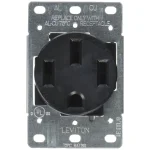
Yes to the cable supports both a 110v and 220v connection. The plug on the wall for 220v must be a 14-50r (usually used for stoves/ranges - 4 prongs, 3 straight slotted and 1 semi-circle for the ground). The 50 in the 14-50r represents 50amp. The plug supplied on the charging cable that comes with your car is 14-50p (p=plug, r=receptical).50A-250V-4-wire-stove-receptacle-outlet-NEMA-14-50R_1000x.jpg
Edit: when installing the 14-50r make sure you mount it with the ground hole on top (opposite of the picture) as the cable for the car has the ground on top.
 
Last edited:
Yes to the cable supports both a 110v and 220v connection. The plug on the wall for e20v must be a 14-50r (usually used for stoves/ranges - 4 prongs, 3 straight slotted an 1 semi-circle for the ground). The 50 in the 14-50r represents 50amp. The plug supplied on the charging cable that comes with your car is 14-50p (p=plug, r=receptical).View attachment 16428
Thank you.
 
Only one caution when using 120v option, check that there are no other high current devices on the same circuit. For example an electric space heater and the EVSE my trip the breaker.
 
Only one caution when using 120v option, check that there are no other high current devices on the same circuit. For example an electric space heater and the EVSE my trip the breaker.

Good advice. Only thing I do with electricy is change light bulbs.
______________________________
 
I can only assume that the charger/plug that came with our '22 GT (build date 11/22) is different from the one having issues. Ours is black with a Lincoln logo and it works like a champ. The unit itself came with two pigtails ... one for 110v and one for 220v.

I used the 110v plug for a few weeks and decided that I needed a better option. I found a device that hooks into our electric dryer plug and automatically diverts the 220v power to the dryer or the Lincoln charger but not both at the same time. I used a long, very heavy duty extension cable to get to the wall where the charger is mounted, hooked up the 220v plug, and it's working as a charm for the past 6 weeks. The splitter was $300 on Amazon and the cable was another $100. Now I charge 0-100% in a little over 3 hours and everything works perfectly. The only issue? My wife and I need to "schedule" the Corsair's charge around our laundry loads ... which occurs about once a week!!

Making things even better ... our local power company has a $400 bill credit/rebate for this kind of EV charger/converter so my net cost was next to $0.

I am also looking into finding a way to charge off of a small solar panel on the roof. The "full" solar conversion quote I got was crazy expensive and they only predict about 40% effectiveness here in rainy western Washington. But ... getting some free electrons into my Corsair's battery from the sun is an intriguing idea!!

Ken
 
Good advice. Only thing I do with electricy is change light bulbs.
I have not changed a light bulb since I switched them to LEDs. You should do that, too, those bulbs will outlast you. 🤭
 
One idea for solar in Washington state is community solar, you buy shares in a large solar project, and offset your local consumption. As an example a site in Kittitas county may see many more sunny days than King county Generation sites gp
 
120 volt only charging here in the garage on a dedecated circuit. I considered going the 240 volt charging route, but don't really need it. So there was no point to it for me personally.
______________________________
 
Some local electric companies offer incentives to install a charger in your home.

For instance, in NJ, our utility company, JCP&L is offering incentives of up to $1,500 for resident installation.

I am still in the process of finding out if I am eligible. I know I attempted to get a charger installation rebate from the State but I was not qualified as the car purchase price was too high.

That may not be the case with the utility company and I am waiting for them to open at 8 am to find out.
 
I have not changed a light bulb since I switched them to LEDs. You should do that, too, those bulbs will outlast you. 🤭
Wait...What are you implying, I only have a finite amount of time on Earth. No one told me...🙃
 
As previously mention in this thread, it MUST be a dedicated line to be safe. Nothing else on it. It may work if it's not dedicated but over time you're likely to have issues and no one wants to burn their house down trying to save a few dollars. I knew my 120v outlet wasn't a dedicated line so I had a local, trusted electrician, look at all the garage outlets, switches etc, on that circuit. Turns out it was 2 overhead garage door openers, two lights (and their switches) and 2 plug receptacles (two plugs each receptacle for a total of 4 plugs). For him to change it to a dedicated line it would only cost $300 more to run a new totally dedicated 220v 50amp 14-50 receptacle. I do have to add the Level 2 "charger" cost to the equation if I want but for $300 difference to future proof for any eventual EV and have peace of mind that I wasn't going to overload a circuit, it was a no brainer.
 
As previously mention in this thread, it MUST be a dedicated line to be safe. Nothing else on it. It may work if it's not dedicated but over time you're likely to have issues and no one wants to burn their house down trying to save a few dollars. I knew my 120v outlet wasn't a dedicated line so I had a local, trusted electrician, look at all the garage outlets, switches etc, on that circuit. Turns out it was 2 overhead garage door openers, two lights (and their switches) and 2 plug receptacles (two plugs each receptacle for a total of 4 plugs). For him to change it to a dedicated line it would only cost $300 more to run a new totally dedicated 220v 50amp 14-50 receptacle. I do have to add the Level 2 "charger" cost to the equation if I want but for $300 difference to future proof for any eventual EV and have peace of mind that I wasn't going to overload a circuit, it was a no brainer.
Good decision.
 
Back
Top